Showing posts with label LEED-CI. Show all posts

Every LEED Certification/Accreditation Fee In One Place

I had a few requests today at work for clarifications on LEED fees, presumably because they're a little hard to find or that they require 3-4 clicks to get to from the main website and my coworkers are lazy (just kidding... please don't fire me!)

expensive hamster

Perhaps an unfair picture for this post, but then again...

As a result, I thought all you LEED power users might appreciate a post that will link directly to fees for every rating system. In each case, fees all versions of the rating system are indicated:

So that's that, and I hope it makes you're life slightly easier... If any of these links break please let me know by leaving a comment!

Residental LEED Projects Already Surpass Commercial Projects in Total Certifications

I noticed a while back from the USGBC updates that residential certifications were quickly catching up to their commercial counterparts. A USGBC Update from 03.11.10 there are now 5,000 'residential' certifications and 4,890 commercial projects in existence, though there are still slightly more commercial registered projects... amazing growth considering the first LEED-NC system was released over ten years ago while LEED-Homes was only launched in April of 2009...

Comparing LEED residential certifications to commercial projects

USGBC Update from 03.11.10

I think this is great news... at this point everyone in the industry knows about LEED, so the only growth in awareness is going to have to come from the general public. As LEED Homes grows in popularity it only stands to reason that the other systems will gain wider recognition and demand as well. Wider demand means better benefits for certification (in higher lease rates and such), which will then spur increased demand for certification, which means more awareness still, and the glorious feedback loop continues on and on...

Details and More Details

When I first noticed this I shot off a quick email to the USGBC communications department to get some clarity on the distinction between 'residential' and 'commercial' projects. (Before you ask... I got a very timely reply... the fault for the delay in the post is all mine!) Residential projects are comprised of residential units, not necessarily project certifications (e.g. a multifamily building with 8 units earning a single LEED Homes rating counts not once but eight times) certified under traditional LEED for Homes or the LEED for Homes Mid-Rise Pilot systems. Commercial buildings are presumably everything else...

The next question I asked was whether the growth LEED Homes speciality accreditations were outpacing the other systems, but the response from the USGBC was that this is not the case yet...

LEED VOC Budget Calculations Explained

I stumbled onto concise but comprehensive article by Chris Dixon in Walls & Ceilings magazine called Straight Green: Alternative VOC Calculation for LEED. Basically, it walks you through the process of preparing a VOC budget (what you need to do if the contractor slips in a non-compliant paint or adhesive) as an alternative compliance measure for achieving EQc4, Low Emitting Materials credits. I could go into more detail, but instead I'll just recommend reading the article for yourself!

LEED VOC Budget

VOC Budget Example

This article was published in 2008, and references LEED-NCv2.2 standards, though my understanding is that the methodology should not have changed in the 2009 edition of the same system, and that it should also apply to LEED-CI, LEED-CS, and LEED-Schools systems.

via 4specs discussion forum

Key Baseline Changes in 2009 Edition of WEc3, Water Use Reduction

I recieved a call from a project architect this morning who had designed a large LEED Core and Shell v2.0 project who in turn had received a call from another architect who is working on a LEED Commercial Interiors v3.0 (2009 edition) upfit of the same building. While we were able to earn 2 points for reducing expected water use by 30.1% in the LEED-CS submittal, when the upfit architects were looking at the water use reductions based on the LEED-CI requirements they determined that the anticipated reduction was only 10.8%. This level of reduction doesn't even meet the new 20% reduction requirement found in the WEp1, Water Use Reduction prerequisite!* What happened? Did we miscalculate the original submittal?

faucet fail

The Unusable Faucet... The latest in water use reduction technology

We (or rather our consultant engineer) didn't miscalculate anything! After taking a closer look at comparing the calculations for both the v3 and v2 editions, we discovered that LEED has adjusted the baseline rate for public faucets from 2.2 gpm down to 0.5 gpm, meaning that while we had substantial flow rate reductions in the LEED-CS v2.0 submittal, none could be claimed for the LEED-CI v3.0 calculation even though the fixture specs were the same. The updated baseline standard applies to v3 editions of LEED-NC, LEED-CS, LEED-Schools, and LEED-CI systems. The change stems from the inclusing of the "maximum [flow rate] incorporated into the national Uniform Plumbing Code and the International Plumbing Code[s]" into the updated requirements. LEED-EB:OM v3.0 sets the anticipated baseline on these standards, but that was the case on the v2 edition as well so nothing has changed there from what I can see.

While the v2 baselines applied a 2.2 gpm baseline requirement for all bathroom lavatories, the v3 system distinguishes between 'public' and 'private' commercial restrooms and residential bathrooms. A private restroom is anything that would regularly be used by only one person at a time: hotel/motel guest bathrooms, hospital patient room bathrooms, and arguably bathrooms serving single offices (e.g. bathroom in the CEO's office used only by that person). All residential bathrooms and these private bathrooms are still held to the same 2.2 gpm baseline as before. Everything else (hotel lobby, shared office, school, and retail and restaurant bathrooms, etc.) are now held to the .5 gpm baseline.

I should point out that I think this is a good change... it's ridiculous to put anything other than a .5 gpm in sinks that will likely never be used for anything other than handwashing or perhaps brushing your teeth, especially when you consider a .5 gpm replacement aerator costs about $2. It also makes sense to keep private bathrooms to a higher standard, since people may be filling coffee pots or other containers that could be annoying if you were limited to such a low flow rate. I've installed a variable flow rate faucet in my kitchen that works great since I leave it on the low setting until I need to fill something up, but my bathroom sink uses a .5 gpm aerator. I should point out that people using on-demand water heaters may have problems in that the flow rate is so low that it may not trigger the water heater to turn on!

Bottom line... I think this is another instance of LEED moving in the right direction by tightening the requirements a bit, but people used to the v2 systems such as myself should definitely make a point to realize that a 20% reduction in v2 is not necessarily 20% in v3. Disagree with me? Please let me know by leaving a comment!

*I should note here that as the bathrooms in question are part of the shared core space of the facility, they should presumably not impact the LEED-CI calculations at all since they are outside of the scope of the upfit**, but any project that upgraded or is considering upgrading from a v2 system to it's v3 equivalent should take note of this change and evaluate the impact on their scores and ability to meet the WEp1 prerequisite.

**NOTE - 02.17.10 - Nathan has questioned the accuracy of the assumption that the existing fixtures would be outside of the scope of the prerequisite in the comments, and I don't have an 2009 IDC reference guide on-hand to refer to so I can provide a definitive answer. I've always been a little hazy on how the scope of a LEED-CI project is set, and since I don't have direct experience in LEED-CI I could very possibly be wrong!

First Look: LEED-CI 2009 Changes From Project Architect's Perspective

An Associate with FXFOWLE recently posted her experience in taking a LEED-CI v2.0 project and switching it over into a LEED-CI 2009 on Building Green's Live Blog.* This very balanced look highlights some of the changes that caused frustration, but also those that made the process easier (notably the use of the Licensed Professional Exemption... more on that later). The article doesn't cover anything, but it's definitely worth reading if you're considering a similar switch.

*Building Green is the parent company of LEEDuser.com, a sponsor of RealLifeLEED. I promise that this post has nothing to do with said sponsorship... it's really a good read!

FREE Unlocked LEED 2009 Checklists That Don't Suck!

UPDATE (07.15.10): The USGBC has now updated the official checklists incorporating pretty much all of the features called for in the post and from your comments! Check out this post for direct links to each of the checklists that are now unlocked, feature a notes section, and highlight whether the credit is part of the design or construction review.

You may have heard me rant about the credit checklists the USGBC has released, and I've finally gotten around to doing something about it. Below you'll find links to Excel checklists for each of the five v2009 (aka v3) rating systems (...if you think I'm going to try to revamp the LEED-Homes checklist you're insane). Each prints to a single page, has an area for notes, and is COMPLETELY UNLOCKED, so if you don't like something you can edit it on your own. I use the notes all the time to keep track of consultant comments and changes... it's the best way I'm aware of for tracking changes in LEED points over time, just put a date in front of the filename and you have a snapshot in time!

NOTE: All five checklists were setup to use the whole page, and you may need to adjust the margins for them to print properly. All five use 0.0" for header and footer, .35" for top and bottom margins, and .25" for left and right margins. Admittedly, those with poor eyesight probably aren't going to like how they print, as the text gets pretty small. I would simply recommend changing it from a one page print to a two page print and adjusting the notes width to get it back to normal proportions.

New USGBC Official Checklists

In the USGBC's defense, they have released (without telling anyone that I can see) new and genuinely improved Excel checklists that feature two tabs: a one-page simplified printing option and a more detailed view similar to past editions. Unfortunately, they're still hung up on forbidding editing of any kind and for some reason have bathed the checklists in a disgusting yellow color. Some may find these new checklists preferable for their purposes though, so I've linked to those directly below for your convenience:

Do you have a pressing need for similar unprotected checklists for older LEED systems (e.g. v2)? Do my checklists stink? Let me know how to make them better by leaving a comment!

Ergonomics Innovation in Design (IDc1) Point

The other day I stumbled upon a wonderful database of ergonomic information from Cornell while looking into some workstation design issues. One of their resources is a description of the requirements to achieve an Innovation in Design (IDc1) credit (or Innovation in Operations credit (IOc1) for LEED-EB) for good ergonomic design.

Get the Doctor!

LEED AP Sez I Need a Backiotomy!

Included on the Cornell page are a worksheet and a survey based on supplementary guidance from the USGBC describing an approved method for achieving this point. Really though all that is required is "the development and implementation of “a comprehensive ergonomics strategy that will have a positive impact on human health and comfort when performing daily activity for at least 75% of Full Time Equivalent building users”. See the Cornell page for more guidance.

New LEED MRc7, Certified Wood Credit Fair But Complex

or

How I Learned to Accept a Change from Simple Imperfection to Torturous Accuracy

Yesterday the USGBC released the 2nd draft of the proposal for a new MRc7, Certified Wood credit for LEED-NC, LEED-Schools, LEED-CI, LEED-CS, and LEED-EBOM. You may remember that this was ultimately spurred by the lumber industry's complaints about how their own certification label, the Sustainable Forestry Initiative (SFI), was unfairly excluded from the LEED credit which only recognized the Forest Stewardship Council's (FSC) more rigorous requirements. You can view the results of a report comparing various lumber certification schemes here. The new proposal is lengthy enough that I thought a summary here, with some commentary, might be useful to you guys.

More Complexity Please

As a result the USGBC's consensus-based process for developing new standards has developed a more inclusive and equitable standard for ranking the standards called the USGBC Forest Certification Benchmark. The new approach is a sort of LEED system within LEED where if a particular forest certification standard complies with over 48 prerequisites and more than 40% of the 32 voluntary credits (sound familiar?), you may attribute the cost of those products towards your "certified wood" percentage needed to earn credit MRc7.

Sample Benchmark Requirements

A sample from page 10 of the benchmark requirements

The more a particular scheme complies with with the voluntary requirements, the greater the relative value of that product you may contribute to hitting your 50% (based on cost) certified wood threshold needed to earn the credit (click here for the new LEED-NC credit draft for yourself):
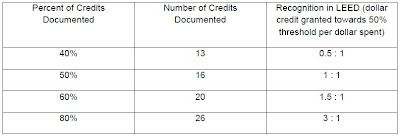
Thresholds

Really compliant schemes now are worth 3x as they actually cost

This may all sound a bit ridiculous, but to be fair, the requirements themselves all seem make good sense and is necessary to thwart claims that the USGBC is in the back pocket of any particular certification body. By establishing a standard for standards, the USGBC can simply point out the deficiencies of any particular standard instead of (seemingly) arbitrarily accepting or rejecting individual groups. I'm by no means a sustainable forestry expert, but given the 1,800 comments received on the first draft I'd be amazed if anything substantial slipped through the cracks.

Please Follow Through With This!

"Building project teams will not be required to determine if a particular forest certification scheme meets the Benchmark’s requirements." So says the executive summary of the proposal, and I can't stress enough how important it is that the USGBC make it extremely easy for LEED APs to find out the status of one certification system over another. If I had it my way, I would only review certification schemes every two years and list all accepted schemes in the reference guide. If it's not in there tough luck, there's always LEED 2011. It's extremely important that I don't need to become an expert on the shifting forest certification system policy... All the USGBC has released on this end of the revisions is the Forest Certification Benchmark Conformance Assessment Process draft, which is a little light on details.

At a minimum, the USGBC should clearly indicate where to find a COMPLETE list of the current status of any particular forest certification system on the USGBC website, preferably on a URL that never changes. This website should be listed not just in the reference guide but also in the rating system itself.

Will my project be affected?

Though the new standard will only be required if you register a project after the date the credit is accepted (still a ways off). Once accepted though, you are permitted to use the new option in existing projects (v2009 or earlier) as an alternative compliance option.

Last Chance to Change

If you're vehemently opposed to this new system or you have some thoughts on how to improve it, you have until October 15th, 2009 to make your voice heard. Anyone can comment, not just USGBC members, but when it comes up for vote it's members only. I'm also curious to hear your thoughts hear, so please share your thoughts by leaving a comment!

Just noticed this is the 100th post!

LEED Commissioning Comparisons

When helping a client prepare packages for a grant they are pursuing, they needed to know how LEED-EB and LEED-CI differed with respect to commissioning (Cx) requirements. A quick search yielded a helpful, plain spoken article, with even more helpful comparison charts (1, 2, 3, 4), in a February edition of Heating, Piping, and Air Conditioning (HPAC) Engineering magazine. The charts show fundamental Cx requirements, enhanced Cx requirements, and scope by system, comparing all major LEEDv2 systems and even pulling requirements from the pilot versions of LEED-CI for Retail and LEED-Healthcare. I'm not aware of any major changes among Cx requirements for LEED 2009 editions of these systems, so everything should still largely apply.

Scope it up

A completely legible comparison of the scope of Cx for each system

I haven't had much opportunity to peruse their website in too much detail, but their Popular Articles section seems to be filled with practical info that I'm going to refer to in the future. Well done!

Full Access to 13 LEED NC and CI Documentation Submittals... MOTHER LODE!!!

This post makes me extremely happy for two reasons. The first is that I can let you know about a website that gives you access to completed documentation for 10 LEED-NC certified projects and 3 LEED-CI certified projects!!! (Sidenote - I realize I've been pretty heavy on the exclamation points lately, but there's just too much good info lately to resist! I promise I'll calm down soon)

The second is that it's a culmination of why I started this blog in the first place. I know a tiny bit about LEED and share it with you, you let me know what I've missed, I share that info, and then we all know everything! Super special thanks to Edgar Farrera of MarmonMok Architecture. Edgar read the post about the free LEED-EB documentation, realized that he knew a far more comprehensive resource, and decided to let me know about it. The result? This post! ...and there we come full circle.

Harvard LEED Certified Building Submittals

Gooooooo Crimson!!!

Not to be outdone by a mere public school, Harvard has amassed an impressive collection of LEED documentation that is very conveniently organized by credit. If ten buildings earned EAc4, then you can see all the buildings that earned it at a glance. There is only one LEED-NC version 2.2 building completed to date (seven for v2.1 and two for v2.0), but they have an additional nine buildings listed as "In Progess". Of those, five are scheduled for completion in 2008, so I'd check back frequently for updates. In any case the only credits they don't have LEED-NC documentation for are:

  • WEc2 - Innovative Wastewater Technologies
  • MRc1.3 - Building Reuse
  • MRc3 - Materials Reuse

I could go on about how great this is and all the features (many of which have not been mentioned), but really you should just check it out yourself.

My new best friend Edgar also pointed out "that the reason some colleges and universities are making this type of information available to the public is that as signatories to the American College & University Presidents Climate Commitment they are called upon to share and disseminate their campus greening initiatives and action plans." This means that it's likely we will see other colleges reporting the same information. If you know of another resource we missed, please let us know by leaving a comment!

Regionalization, Public Comments, and LEED 2009... Oh My!

or

Your One Stop Shop to Understanding The Proposed LEED 2009 System Without Sifting Through 8000 Pages USGBC Material

NOTE - 03/28/09 - As the new LEED 2009 reference guides have been released, I poured through page by page to give you detailed review of the changes which can be found here. It's still worth reading below for a general introduction, but the new post reviews what was actually approved.

Well folks... just as you get comfortable with LEED 2.2 it's time to start gearing up for the release of LEED 2009 - formerly known as LEED 3.0. (I guess USGBC is taking it's cues from Autodesk, Microsoft, etc. on coming up with new naming conventions every few years to keep things "fresh"). As the resource for LEED AP's everywhere, Real Life LEED is here to give you a concise and poorly copy-edited guide of overviews of major changes and a plea for all those who like to bitch about LEED to actually submit comments and change the system!

What's Changing?

The "LEED 2009 Vision and Executive Summary" basically states that LEED is growing at an exponential rate, will now start to be revised on a periodic basis much similar to code improvements, incorporate a "transparent environmental/human impact credit weighting" scheme, and add some form of regionalism into the point system. LEED-NC, LEED-CS, LEED-CI, LEED-EB, and LEED for Schools are all being edited under the new system.

The credits themselves are barely touched. Looking at the updates to LEED-NC, only a few things jump out at me. Your water use reductions jump from 20%/30% to 30%/40% and the 20% threshold is now a prerequisite. The EAc1 points are now based on ASHRAE 90.1-2007. The credit for CRI Green Label carpets (EQc4.3) is now expanded to include pretty much all other flooring options. There are now "bonus" points that you can earn that are dependent on the building location (see explanation below).

Other than that, the changes are mostly semantic clarifications and updated "Requirements" sections that incorporate the latest credit interpretation rulings (CIRs). You can see the updated LEED 2009 draft rating systems at the following links - all in annoying .zip format!

Credit Weighting

The easy to use 10-step weighting process (<-sarcasm) that is proposed is described in a series of utterly incomprehensible documents that can be found here. My best summary goes something like this:
The reason for the weighting change is that points were previously assigned in a less than scientific way and the USGBC would like to have a better argument for why one credit is assigned a higher point value than another. The new weightings are based on a complex system based on the EPA's "Tool for the Reduction and Assessment of Chemical and Other Environmental Impacts", aka TRACI. In an effort to provide transparency, the USGBC releases far more information about the weightings than any reasonable non-academic should be willing to digest. Credits related to energy use, water use, and transportation now have more impact on your total score. Credits related to siting (non-energy related), materials, indoor environmental quality, and waste managment have less of an impact. Overall, I think the changes make sense. Using the proposed LEED-NC point allocations, water use eekes up from 7% of the points to 10%, a number I think should go even higher. Energy use now accounts for 35% of possible points instead of 25%, and transportation credits (SSc2 and SSc4.1-4.4) make the biggest jump from 7% to 17% under the new system. Long story short, all of the systems under review will know have 110 points including 5 Innovation and Design points, 4 "Regionalization" points (see below), and 1 point for having a LEED AP, which is now separate from the other ID points. The new thresholds for certification levels are as follows:
  • Certified: 40-49 points
  • Silver: 50-59 points
  • Gold: 60-79 points
  • Platinum: 80-110 points

Regionalization Credits

There is no information currently available as to what these points will look like. All I've been able to find in the documentation provided by the USGBC is that "These Regional Bonus Credits will be identified by the USGBC Chapters and Regional Councils for each “environmental zone” and a maximum of four points are available for project teams to pursue. This work is currently underway."

It sound like each USGBC Region will have the authority to create six potential bonus credits, of which you may pursue a maximum of four. This is a very good idea, though it will be interesting to see how the balloting process (if any) is handled within each region. Being from coastal South Carolina (the land of 100% humidity), I would love to credits for harvesting water from air.

Yes... I know this is a horrible photoshop effort

Public Comment Period Ends June 22nd!

Have a problem with the LEED system? Now's your chance! Be sure to comment on the draft 2009 systems before the deadline to make your voice heard. I get so frustrated when I hear people complain about LEED seeking to serve private interests when the whole process is so democratic...

What are your thoughts on the system updates? Share them with us in the comments section, after you share them with the USGBC first of course!
