Showing posts with label project management. Show all posts

GBCI News Feed Gives You Latest LEED Announcements

I recently stumbled on the GBCI Announcements feed, and it's already led me to discover a few helpful tools that I wouldn't have otherwise known existed (CMP Wizard, anyone?) While some of the feed is the press release variety, many posts cover tools and updates to the documentation process to make it worth scanning at least once a month or so.

Threads are forum topics

They conveniently created a set of RSS feeds to narrow your topics down. Don't know what an RSS feed is? You need to learn! They make the interwebs function. Even Real Life LEED has an RSS feed.

New Guide Provides Instructions For Setting LEED Project/Campus Boundaries

Shortly after complaining about changes about new policy documentation from the GBCI, it occurred to me that the USGBC also published a much needed updated to their Application Guide for Multiple Buildings and On-Campus Building Projects (2010 AGMBC) that does a good job of clarifying how to document 'weird' site conditions. The previous 2005 edition did not have much guidance for how to determine LEED Campus and Project boundaries, an issue the new guide explains in easy to use terms.

If this is your campus boundary, you may want to consider downsizing it a bit

Though both documents provide guidance on how to calculate specific credits when multiple buildings on a similar site are seeking certification, I'm most interested in how to set the Project and Campus boundaries. This process is as much art as it is science, and the new guide goes so far as to say that "guidance on where to draw the LEED Campus Boundary is intentionally non-specific". This is a good thing, because boundary issues for an urban project with multiple buildings on one well-defined site are going to be different than the issues a campus may face when certifying a single building on a site where the school owns thousands of acres.

Key Issues

Project vs. Site Boundary - For 'normal' projects (I'm not sure I've worked on a 'normal' project yet!), you create a single LEED Project Boundary where all credits are calculated based on what happens within that zone. This is normally supposed to be the legal limits of the site, but many times multiple buildings will eventually be built in Multiple building or campus projects will frequently have two boundaries, a Project Boundary and a Campus Boundary.

  • The Campus Boundary is normally the entire area that the owner (normally a large developer or university) owns or has control over, but in some instances it will be a subset of that property (e.g. a 'quad' of a university campus or one phase of a master development). The purpose of the campus boundary is to allow the project team to take credit for shared infrastructure (e.g. stormwater mitigation efforts, dedicated open space, structured parking) that may serve the project but is not part of the scope of the specific project seeking LEED. It may not contain areas outside of the legal control of the organization seeking certification (e.g. off-campus areas can not be included just because there's a park there that would help with an open space credit)
  • The Project Boundary is contained completely within the campus boundary, and is defined as "all land that is associated with and supports normal project operations, including all land that was or will be disturbed for the purpose of undertaking the LEED project." In other words, it's the area you're actually affecting when building the specific project seeking certification. The project team has reasonable discretion in determining this boundary, and past experience has indicated that review teams will accept anything that isn't clearly 'juked' (e.g. including a sliver of a site to connect your project to a park to earn open space).

There's more to it than stated above, and I strongly suggest you and your consultants read the guide and then sit down to determine boundaries as a group to make sure all credit impacts are considered. In past projects I've worked on, stormwater mitigation and light pollution credits had the biggest influence on these boundaries, but parking, open space, and a variety of other credits could come into play as well.

I'm heading to Greenbuild 2010 today... Hope to see you there!

LEED-ND Study Examines Entire Metro Area

I've been looking at LEED for Neighborhood Development (LEED-ND) in some detail lately, as evidenced by posts examining the system's fees and also my first experience planning the certification process. While I'm starting to get a feel for the system, my efforts pale in comparison to the work of Brendon Slotterback over at NetDensity.net:

Twin Cities LEED-ND Eligibility

Areas Meeting LEED ND Minimum Eligibility Requirements in the Twin Cities

Brendon's apparently excellent GIS mapping skills allowed him to progressively eliminate areas ineligible for LEED certification due to non-compliance with various Smart Location and Linkages category prerequisites, and the result is the chart above of eligible areas across the entire Minneapolis/St. Paul metropolitan area. You can read all of the four part series by clicking the links below or through this summary page on his website.

  • Part 1: Includes a brief overview of LEED-ND and the HUD decision to begin scoring grant, and then creates a map excluding all areas in the region that do not meet wetland/floodplain avoidance, agricultural conservation, and endangered species habitat protection requirements (i.e. examines compliance with SLLp2-SLLp5).
  • Part 2: Focuses almost exclusively on the SLLp1, Smart Location and Linkages prerequisite and its myriad requirements.
  • Part 3: Examines areas that may technically be eligible for certification but have strong market barriers due to poor connectivity or low density in the surrounding areas.
  • Part 4: Brings it all together and looks forward to zoning and policy recommendations that would help foster greater adoption of these practices in the future.

Does LEED-ND Get It Right?

I found Brendon's site via commentary from Kaid Benfield on his own blog over at the NRDC. He was particularly interested in the ability for small towns and rural areas to meet the SLL requirements, and judging by this post he feels that the system works.

These posts led to a lively discussion on a local planning list I subscribe to, where one respondent was upset that a local new urbanist community planned by DPZ, Habersham, would not qualify due to the fact that it's not an infill project surrounded by dense development. It's an excellent development internally, not far enough away from the existing town to in my opinion be considered contributing to sprawl, but it is located on a greenfield surrounded by river and marsh on one side and not much other than forests on the other. Our conversation happened to align with a visit from Steve Mouzon, author of The Original Green, who summed up the discussion well:

Currently, LEED-ND is based primarily (but not entirely) on the assumption that most meaningful interactions occur outside your neighborhood. So Pienza would fail. As would Key West. As would any number of New Urbanist places, including Habersham... LEED-ND doesn't "trust" very much that the developer will, over time, be able to capture very much interaction... LEED-ND doesn't have very good accounting of time at this time.

It’s clear to me that LEED-ND requires not only good development practices but is also fairly strict about where such development occurs. I see this as a positive but am very interested to hear your thoughts. Should Key West, a town that could literally be wiped off the map if sea level rise predictions come true, be a place that LEED-ND should foster? Should LEED-ND be more forgiving if what’s developed is significant enough to create its own town center, or should we only encourage growth of existing town centers? Please share your thoughts by leaving a comment!

A LEED for Neighborhood Development Project Planning Guide

Today I was tasked with determining the implications that pursuing LEED for Neighborhood Development (LEED-ND) certification would have on current, preliminary plans for a roughly 100 acre mixed use development including a retail center, offices, and a mix of single- and multi-family residential. Though generally aware of LEED-ND this is the first time I've tried to apply the rating system to a specific project, and I figured many of you will be in the same boat sooner or later. With that in mind, here's what has jumped out at me as the major issues we'll need to discuss with the client. If you have absolutely no idea what LEED-ND is or what it attempts to do, I strongly recommend checking out this short video before continuing.

The Bluth's were never known for their commitment to sustainability

The Bluth's Development would probably not qualify for LEED-ND

To create this analysis and resulting post I've been relying on the rating system document, the LEED-ND Reference Guide, and the nine page LEED-ND Certification FAQ. I would strongly suggest reading the "Introduction" and "Getting Started" sections in the reference guide and the FAQ as they contain a gold mine of administrative issues that you'll want to know about at some point. I'm hitting the high points in this post, but there's a great deal more info that you'll want to at least skim so you don't run into any nasty surprises. If you're not aware already, it's nearly impossible to pursue LEED certification without purchasing the appropriate reference guide for it.

Understanding the Process

Unlike most LEED rating systems, LEED-ND uses a three phase review system, though depending on where you are in the planning stage you may not need all three. Each review follows the same format as the commercial LEED rating systems (i.e. submit review, receive preliminary comments from GBCI, amend as necessary and resubmit, receive final comments from GBCI, and appeal or accept the rating as granted).

Stage 1 - Conditional Approval of a LEED-ND Plan (Optional)

This review is designed to "help the developer build a case for entitlement among land-use planning authorities, as well as attract financing and occupant communities", and can only be pursued if "no more than 50% of the project's total new and/or renovated building square footage has land-use entitlements... for the specific types and quantities of... land uses proposed." According to the rating system language, entitlements are defined as "the existing or granted right to use property for specific types and quantities of residential and nonresidential land uses." I read this a "zoning is in place".

Confused? So was I at first, but basically all this is saying is that if zoning is already in place for more than 50% of your total project as it will ultimately be built, you skip Stage 1 and move to Stage 2. Their definition of entitlements is based on planned building area, not land area. So even though I may have 75 acres out of 100 zoned how I want, if over 50% of my building square footage is in those last 25 acres (perhaps the neighborhood core?) then I'm still eligible for Stage 1. If zoning is not in place for 50% of the total square footage of the project, you may pursue this certification, but you're not required to. The impression I get reading through the guide is that the only people who should pursue a Stage 1 review are those developers who need help convincing local boards or zoning administrators that their plans are indeed sustainable and could benefit from a USGBC seal of approval of said plans.

Stage 2 - Pre-Certified LEED-ND Plan (Optional)

You can't proceed with Stage 2 until 100% of the entitlements are in place (i.e. finish up your zoning then move on). So now you have that in place and all of your design work is completed, but it's going to be quite some time before this place is completely built out... This is the time to submit for Stage 2 Pre-certification!

Similar to the goal of Stage 1, the intent of pre-certification is to aid the developer in marketing, except this time to potential tenants and not zoning boards. Since many projects have long timelines for development, it's likely that more than a few will pursue Stage 2 pre-certification and stop there. One developer who participated in the pilot project system with a 25 year development timeline indicated that this is a likely outcome for them.

Stage 3 - LEED-ND Certified Project

This stage is the real deal, and once you reach it you finally have a certified project and a plaque to put somewhere. One question I have is that based on the information provided in the reference guide and other supporting documents, it's not clear whether a well prepared Stage 1 or Stage 2 documentation set would look much different than what's provided for Stage 3. Multiple sections of these documents suggest that more information and guidance on the matter is provided on LEED-Online, but at the moment I don't have access to that info. I've sent inquiries to the USGBC on this matter and will update this post when I hear back.

Now that I've likely thoroughly confused you about the different stages, here's a graphic from the reference guide that should make it much clearer. The introductory sections provide much more guidance and helpful charts regarding site drawings and documentation that is not found in the free rating system document:

LEED Neighborhood Development (LEED-ND) Stages Explained

Click to view full size

Fees

As mentioned in an earlier post, LEED-ND fees aren't exactly cheap, but when you start to divide the cost over every building it starts to look much more favorable compared to certifying each building independently.

For the 100 acre project I'm examining the total direct certification fees paid to GBCI (i.e. not including consultant costs) for one stage would be $1,500 registration + $18,000 for the first 20 acres + $350 * 80 additional acres = $47,500. That sounds steep, but when you consider that the cachet of LEED will fall upon the 334 buildings (34 commercial + 300 residential) within this area, likely a significant marketing bonus for all properties, that breaks down to only $142/building. If two stages are pursued (in this instance Stage 2 and Stage 3 are most likely), the total fees rise to $85,500 for both, or $255/building.

When I wrote the previous post I was under the impression that a project was forced to seek all three stages of certification at considerable cost, but looking into the matter further it appears that a project may only need to complete one or two stages and can save significantly. I'm not 100% clear on this and have sent a request to the USGBC for clarification and will update this post when I have confirmation. It's important to note though that at least one building must achieve LEED certification of some form in order to satisfy a prerequisite, and additional points may be earned for additional certifications under the Green Infrastructure and Buildings category.

Who's on the Team?

Far more than any other LEED rating system, a good civil engineer or formal planner, ideally with a fair amount of GIS mapping experience, is critical to making the LEED-ND certification efforts proceed smoothly. You will be creating a LOT of site and vicinity maps to comply with Smart Location and Linkage and Neighborhood Pattern and Design prerequisites and credits. I admit that a layperson could likely handle most of this, but it will be very time consuming without a working knowledge of GIS software.

One of the Green Infrastructure and Buildings prerequisites requires that all commercial buildings be designed to exceed ASHRAE 90.1-2007 (by 10% for new buildings or 5% for renovations) or smaller structures can meet detailed prescriptive requirements. Residential buildings must comply with Energy Star ratings. All projects must certain plumbing efficiency requirements. For this reason, it's likely that an MEP engineer will need to be involved in the documentation process as well, but not to the same extent as the single building LEED systems.

A developer who handles most of the design in-house can probably survive certification without needing an additional consultant, but if they don't have some of the skills mentioned above it will be a very frustrating process. Alternatively, an architecture or planning firm could also provide a great deal of the documentation for a developer. At the end of the day it will come down to who can do the paperwork most efficiently, and in my opinion that is almost always the person handling the design the first place.

What to Look for First

Unlike other LEED systems where the prerequisites can generally be achieved on any site, it's very likely that it will be impossible to certify greenfield, surburban sites if there's very little or poorly connected infrastructure. The project I was tasked with examining will very likely not qualify for certification due to the fact that the neighboring sites are not very dense and it's bordering undeveloped parcels for much of the site boundary. Internally, the developer must be willing to commit to certain density requirements and also pursue a very urban style infrastructure with building frontages bordering streets instead of vast arrays of parking. For your convenience, I've briefly summarized the most critical prerequisites below so you can check to see if your plan will qualify. There are other prerequisites to consider, but these are the ones you need to know about before you pay a registration fee... For more detailed descriptions of the credits, download a pdf copy of the rating system itself.

Site Location and Linkages

SLLp1: Smart Location - This is the one that will prohibit greenfield, urban fringe projects from qualifying. The site must be currently served by water and wastewater service or "within a legally publicly planned water and wastewater service". In addition to that requirement the project must be an infill site (see credit for details, but it's pretty much what you'd expect), OR at least 25% of the project boundary must be immediately adjacent previously developed property while land within a 1/2 mile radius contain an average of 90 intersections/square mile. Confused? Even the free rating system pdf has good maps clarifying the credit.

SLLp3: Wetland and Water Body Conservation - Want to fill in some wetlands on the site? Not going to happen... It's going to be very difficult even building within 50 feet of wetlands or 100 feet of water bodies (beyond minor improvements like paths), which is prohibited unless you meet stringent stormwater management and density requirements.

SLLp4: Agricultural Land Conservation - There are significant restrictions to building on land "within a state or locally designated agricultural preservation district".

SLLp5: Floodplain Avoidance - If your site is within a 100-year floodplain, it better be an infill project or previously developed, otherwise you're not going to be able to build there at all.

Neighborhood Pattern and Design

NPDp1: Walkable Streets - Technically you don't need to know this prior to design starting, but the developer should probably be warned as these will significantly shape their project. 90% of all new building facades must directly border "public space, such as a street, park, paseo, or plaza, but not a parking lot, and is connected to sidewalks..." Additionally, sidewalks must be provided on both sides of 90% of internal streets or frontage, and no more than 20% of street frontages can be faced by a garage door. There are also street width to building height ratios that must be followed for at least 15% of the development.

NPDp2: Compact Development - For projects located within walking distance of a transit corridor, you must build to a minimum density of 12 units/acre residential and .80 FAR for commercial spaces. Projects not within walking distance of a transit stop must build to a minimum 7 units/acre residential and .5 FAR for commercial.

NPDp3: Connected and Open Community - Internal streets within a project must average at least 140 intersections/square mile and there must be "at least one through-street and/or nonmotorized right-of-way intersecting or terminating at the project boundary at least 800 feet." No one way in, one way out developments here!

Green Infrastructure and Buildings

This category has three prerequisites, but they are all to be tackled much later into the design process. Basically you have to have at least one LEED certified building within the LEED-ND project, and all buildings in the development must meet minimum energy and water efficiency requirements.

Use at your own risk!

It's important to note that this is my first review of these credit requirements, and though I work to ensure this blog is as accurate as possible, I shortened many complex credit requirements down to only hit the big spots. I may have also overlooked small details that would provide exceptions to the statements below. This post is intended to get someone who hasn't cracked the book up to speed about LEED-ND as quickly as possible, but it's ultimately up to you to read the reference guide and meet all of the requirements. Please call out any mistakes or differing opinions in the comments and I'll update the post ASAP.

GBCI: 94% of LEED Reviews are Currently On Time

Tristan Roberts of Environmental Building News* recently wrote an article about how the GBCI is shifting LEED reviews back to the GBCI in an effort to reign in "inconsistencies and poor service that have been frustrating to LEED project teams." I was more interested in a statistic cited later in the article, where GBCI President Peter Templeton "cited internal figures showing that 94% of reviews are currently on time, which is up 45% from the start of 2009." You may remember from earlier posts that the delays in 2008 and 2009 could be pretty long, and I'm glad to see USGBC/GBCI's commitment to improving customer service is paying off!

Cracking the whip!

Cracking the Whip on the LEED Reviewers**

Recent personal experience with LEED reviews confirms that this is true... Normally the initial review appears to be taking most of the 25 business days, but we've found relatively quick turnaround on final reviews.

*Full Disclosure: EBN is owned by parent company BuildingGreen, a sponsor of this site.

**No LEED reviewers were harmed in the making of this post... or even really featured in this picture

Learning from the LEED-Homes Platinum 100K House

A few years ago, Chad Ludeman and Nic Darling of Postgreen embarked on a journey "to build a LEED Platinum home for $100,000 in hard construction costs." Lucky for you, they not only succeeded but documented the entire process on their popular 100K House blog!

100K House

Image credit: Postgreen

While their blog covers topics beyond the original project and is definitely a recommended read as a whole, I wanted to highlight some of the posts I found most helpful for LEED APs embarking on a LEED-Homes project... or you could just go directly to the 20 posts under the LEED category:

New readers may not be aware of a similar that that I profiled a over a year and a half ago (has it been that long???), The Lambert LEED Home. Know of other great LEED Homes resources that deserve attention? Let us know by leaving a comment.

SUCCESS! New Official LEED Checklists Unlocked, Added Improvements

Though the primary goal of RealLifeLEED is to better inform project managers and others involved in LEED documentation, every once in awhile I put up a rant about some topic that's bothering me in the hopes of bringing attention to something that needs to be fixed. Fortunately, it looks like the USGBC is listening, as yesterday I received a comment from Courtney Yan at USGBC explaining that:

"In response to feedback we've received from you and others, we recently updated the checklists available at usgbc.org. Revisions include the addition of d/c designations, adding a notes section and unlocking the detailed version."

The New Look Of LEED (Checklists)

While I may be appear harsh towards the USGBC/GBCI at times, I do recognize that we all share the same goal of improving the quality and reducing the environmental footprint of our built environment, and they deserve recognition for identifying a problem and working to fix it. I'll leave my previous post featuring links to checklists I created up, but I would encourage you to check out the new UNLOCKED excel checklists provided by the USGBC as well, since they've refined them even further than my editions:

Are there other improvements you think still need to be added? Suggest them here by leaving a comment!

Special Recognition

In my last post I forgot to congratulate the winner of the mini-contest where I asked readers to identify why the hell I featured two people sipping big gulps in a post about daylighting. My new best friend and suspected hipster (single speed... check! v-neck... check! manpurse... check!) The Beastmaster, authors two blogs (one for him and one for his family) and correctly guessed that the picture featured Matt and Kim, a band best known for their single, Daylight! Congrats!

The Cost of LEED Review: Relatively Great, Specifically Problematic

A few weeks ago I was provided with a copy of The Cost of LEED whitepaper ($49 + shipping) from BuildingGreen*, and I must say I'm impressed. The report is by no means flawless, but it's the first one I've seen that provides designers with a credit-by-credit 'back of napkin' figures to use to calculate cost premiums for various design strategies.

To my knowledge the only thing that even comes close is a useful but (in some ways) less detailed study from the GSA in 2004. It's worth noting that the GSA study is free, but is limited to GSA office and courthouses for its scope and does not list specific construction cost premiums for each credit. Let's take a look at a sample page from the BuildingGreen report to get a feel for the document and then I'll offer up some pros and cons: Example Credit Report - WEc3

Sample Credit Report for WEc3 - Click to view Full Size - Reprinted With Permission

This profile of credit WEc3, Water Use Reduction is fairly typical... setting 'conventional' systems as the cost baseline and indicating specific premiums for various upgrades that may be used when pursuing the LEED points. It's important to point out that this is probably one of the longest credit reports in the whitepaper, as more than a few strategies (e.g. SSc1, Site Selection or SSc4.1) are so dependent on local site factors as to be unquantifiable in any realistic sense. Assumptions are pointed out when appropriate and in general I feel like you're provided with enough information to make adjustments on the fly if you have strange circumstances. The report only covers the LEED-NC v3 rating system, so if you're pursuing anything other than LEED-NC or LEED-CS this report will be of limited value.

Cons

I see two major problems with this whitepaper. The first and most significant is that soft costs of LEED (energy modeling, documentation fees and the like) are not provided. I think the soft costs component of LEED premiums have not been discussed sufficiently as an industry, and from my limited experience I've found fees still vary significantly from consultant to consultant. I would have greatly appreciated a section that attempted to provide some ground rules for costs from civil engineers, MEP engineers, architects, contractors, specialty LEED consultants, etc. It's worth noting that commissioning costs are the exception to this rule and are included in the report. It's also worth noting that the GSA study takes a stab at soft costs (see page 6), though it lumps all parties into a single figure that isn't terribly useful.

The second lies in the accuracy of the specific costs listed for each specific measure, and I could be off base about this. Not being a cost estimator myself, I've taken informal polls from a few people in design and engineering fields locally, and the consistent response is that the costs 'seem high'. I think this is likely due to the fact that "cost data is based on northeastern US construction costs from 2008." I'm in South Carolina, and it only stands to reason that everything would be cheaper here, but that doesn't change the fact that those costs would likely need to be adjusted across regions and time. In their defense, these issues are presented right up-front in the Assumptions and Qualifications section.

Pros

Ultimately the strength of this report lies in the "Construction Cost - Relative Percentage" tabs for every credit. The simple multipliers allow you to consider the impact of adding credits early in the design phase, and the Cost Synergies section helps ensure you're not making those decisions in such isolation as to not understand the impact on other points you may be considering. It allows you to have an answer, however rough, when a client asks you a question like, "How much would it cost if we decided to switch from our dark roof to a light TPO membrane?" The use of concise charts allow you to do this in a report that is only 47 pages, yet at the same time it includes at least one strategy I haven't even heard of (e.g. aircuity systems).

*FULL DISCLOSURE: BuildingGreen operates LEEDuser.com, a sponsor of this site. The copy of the Cost of LEED report was provided free of charge for review purposes. That said, I stand by the review I've posted as an accurate and un-biased portrayal of the report's value, and I would make the same report even if LEEDuser were not a sponsor of this site. If you feel I've overlooked or omitted anything important please speak up by leaving a comment!

5 Ways Your LEED Project Can Be Challenged, Cancelled, or *GASP* Revoked!

Though it hasn't received a tremendous amount of attention*, part of the LEED v3 updates included various paths by which LEED project registrations can be cancelled and people can challenge existing LEED certifications and possibly have those projects' LEED status revoked!

If you haven't browsed it yet, I would highly recommend flipping through the GBCI LEED Policy Manual, which lays out the basic regulations surrounding these and other issues that you should know about before starting a LEED project. The following headings are largely copies of the chapters in the policy manual (pgs 12-17), but I've shortened the text to show only the critical requirements in each category

1. Your Project Wasn't Submitted Before the Rating System Sunset Date

With the start of LEED v3 the GBCI instituted a 'registration cancellation policy' that sets a few deadlines that you have to meet or else the GBCI is authorized to void your registration. The "'Sunset Date' refers to the date occurring six (6) years after the close of registration for a rating system version." e.g. Registration for LEED-NC v2.2 closed on June 26, 2009**, meaning that at least a design certification review for a LEED-NC v2.2 project must be submitted by June 26, 2015 or the GBCI can decline to review the project. If you submit a design review before the sunset date you have up to 1 additional year from the date of the design submission to submit the construction review.

I don't really have a problem with this requirement, as the GBCI can't be expected to staff reviewers with knowledge in every version of the rating system since the beginning of the LEED over 10 years ago. 6 years should be ample time even for the longest project schedules (though possibly not LEED for Neighborhood Development). It also appears as though this requirement applies retroactively, as the USGBC closed reviews of LEED-NC v2.0 projects on December 31, 2009. To date, the USGBC has offered free 'upgrades' to new systems as their launched, though there's no guarantee this will happen in the future.

Simply Terrible...

Let's a take a moment to admit that some cancellations are for the best

2. Your Project Has Been Inactive on LEED Online for Too Long

"GBCI reserves the right to cancel any project that, as determined solely by GBCI, remains inactive for a period of four (4) years or more." The note goes on to say no refunds will be provided. I'm not wild about this requirement, as I can't figure the purpose. I suppose it's to prevent crafty LEED administrators from purchasing a bunch of registrations well in advance of actually starting projects so that they may lock in the typically less restrictive requirements of earlier systems. Just because the GBCI can revoke a registration in this manner doesn't mean they will, and I would assume some sort of warning would be announced to the project administrator prior to shutting it down. I still don't like it though, because it seems necessary given the sunset date requirements.

3. You Waited Too Long to Submit After Project Completion

The new rules also state that an NC, CS, or CI project has no more than two years after the "Project Completion Date" to submit for review. I'm also a little unclear about the purpose of this requirement. In every project I've worked on the owner provides plenty of incentive to get the certification finished, and I don't know why the GBCI cares either way how timely the submittal is tied to the completion date. Again it seems like the sunset dates should be the only really necessary restriction.

4. Someone Challenged Your Certification Rating (and They Were Right)

While the registration cancellation policies discussed above are pretty straightforward, the Certification Challenge Policy is an interesting can of worms in that anyone can initiate regardless of their involvement in the project. These challenges occur after a project has completed the certification, and can result in anything from a loss of one or more points to a complete revocation of the certification altogether. It's not just credits that are potentially considered, but also compliance with the Minimum Program Requirements.

A formal investigation can be launched by the GBCI itself without third party complaints or by anyone in the general public, though they cannot do so anonymously... From the policy manual:

Persons desiring to make a complaint may submit a written statement identifying the persons alleged to be involved and the facts concerning the alleged conduct in detail, and, to the extent available, the statement shall be accompanied by any available documentation. The statement shall identify others who may have knowledge of the facts and circumstances concerning the allegation. The person making the complaint shall identify him/herself by name, address, and telephone number.

Once a complaint has been filed, no one less than the GBCI President him/herself reviews the complaint (with the help of their legal counsel, of course), and can either dismiss the complaint immediately if deemed frivolous or initiate an investigation that can potentially include further documentation from the project manager or owner or even include site visits. Should the GBCI determine there was indeed some form of false representation or inaccuracy in the original submittal, there's a whole load of notifications, appeals and such that I'm not going to cover here. I'll assume that should this ever happen to you you're likely to take the time to read the policy manual yourself!

To my knowledge there has been only one certification challenge to date. It was against the LEED Gold certified Northland Pines High School in Wisconsin... The GBCI has at this point denied the challenge and elected to maintain the certification, but a new post today from the Green Building Law Update shows that the five challengers haven't given up... Interestingly, all of those involved in the challenge (an architect, a developer, a contractor, a chiropractor, and a 'local businessman and community leader) served on the building committee for the project. They recently released all of their challenge documentation and a statement about their dissatisfaction with the denial of the challenge. I'm not going into it here, but it gets pretty interesting when you consider their claim that "[The GBCI] based [the denial of the challenge] on reports from two more consulting engineers who said that the building did not meet the prerequisites but concluded that “pretty close” is close enough." I expect that we'll hear far more on this in the near future.

5. You Forgot To Recertify Your LEED-EB Project

LEED for Existing Buildings projects must recertify the project every five years to maintain their certification. It is the only rating system that requires re-certification at this time and this is nothing new... it's always been this way.

*It hasn't been discussed much except by Chris Cheatham, founder of Green Building Law Update, who can't seem to shut up about it lately... Seriously though his coverage of the LEED Certification Challenge policy is a highly recommended read, especially as the ongoing drama surrounding the Northland Pines project develops. The Green Real Estate Law Journal also has some coverage but without as much commentary.

**EDIT 07.12.10 - Thanks to alert reader Mara Baum for pointing out that I had the wrong date for the close of registration for LEED-NCv2.2. I had originally listed April 27, 2009, the day LEEDv3 registrations went live. The date LEED-NCv2.2 registrations closed, however, was June 26, 2009, and that is the day the sunset clock started to tick...

Must-See FREE Resource: Building Commissioning (Cx) Blog

A few days ago Mark Walter of Virtual Cx dropped me a link to his blog, appropriately called Building Commissioning. Billed as "the largest Building Commissioning blog in the United States", there is an even mix of system profiles, commissioning (Cx) guidance, Cx cost/benefit info, and standard/code development commentary in it's 100+ posts and articles. Though a corporate blog, he doesn't seem to be too concerned about pitching his service (which is an interesting concept on its own), but instead sticks to creating a resource that reads like it was actually written by a commissioning agent (CxA) and not some intern 'specialized in web 2.0'...

I wish I knew enough about Cx to write this stuff!

The posts constantly link to things like the "Practical Guide for Commissioning Existing Buildings" (from an 1999 ORNL report), the IT Handbook for Energy Efficient Cooling (in a post about Cx guidance to limit hot spots in data centers), and a sample Cx kickoff meeting agenda (in a post about... sample kickoff meeting agendas. Let's see you top that, web 2.0 intern!).

Is there another Cx blog I've missed? Let us know by leaving a comment!

Online Tools for LEED Project Managers Presentation

I just finished up an education session at the USGBC South Carolina conference I mentioned previously. As I promised the attendees earlier, I've loaded the presentation online so everyone can take full advantage of the links included.

For regular readers who didn't attend, many of the links are already featured on the right side of the screen, but I did some research to find free online GBCI CE credits (a topic I'll be covering in detail in the next few weeks) and a few other resources that I haven't posted elsewhere. When I'm no longer completely exhausted, I'll likely edit this post to place all the links in one place and add a few images. Until then, enjoy!

LEED ND Launches April 29th + First LEED AP ND Specializations Earned

After a refreshing weekend in the desert of California (ok... technically I was on a giant polo field), I came back to find a few important announcements about the LEED for Neighborhood Development (LEED-ND) rating system, namely that there are now LEED AP ND specialists out there and that the system is going to be launched on April 29th!

LEED for Neighborhood Development (LEED-ND)

Did I mention that I'm digging the LEED-ND logo?

LEED-ND To Be Launched On Thursday, April 29

According to a press release forwarded by the USGBC Wednesday morning, there are going to be a set of meetings in Chicago and Washington, DC where R. Fed and company will "launch the LEED for Neighborhood Development (LEED-ND) rating system" and it will be available online for registration at that time.*

First Batch of LEED AP ND Specialties Awarded

I found out about this through a less official but no less accurate source, as a friend of mine let me know that he just received a letter from the GBCI indicating that he had passed the beta test for the LEED AP ND specialty. The 'normal' test won't be live until June 11, 2010 (see the candidate handbook for eligibility and logistical details), but it appears as though you can apply to take the test right now. Ladies and gentlemen I present to you Nathan Schutte, the first LEED AP ND worldwide (as far as I know**), on the links lamenting the lack of development density while enjoying the access to green space:

Leading us straight to sixth place...

Nathan had already passed the LEED-NC v2 AP exam, but was interested in learning about the system oriented more towards planning than building design. Since the beta test was free he decided it couldn't hurt to try. He said of the experience: "This test was the biggest kick in the teeth I've experienced." In other words it was hard, which is not terribly surprising but helpful to know anyway. He had worked on LEED-NC projects before, one of which happened to fall within a LEED-ND pilot project, and my understanding is that he used the LEED Reference Guide for Green Neighborhood Development as his study tool.

Were you in the group that took the LEED ND beta test? Let us know about your experience by sharing a comment!

*This section was edited on 04.22.10 after the USGBC Communications Department confirmed that registrations will be live on 04.29.10.

**Meaning this could easily be incorrect, but presumably all beta testers were notified at roughly the same time.

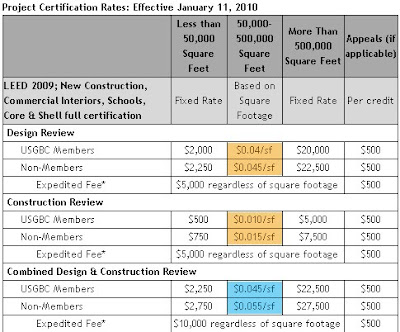
New LEED Fees Discount Combined Design And Construction Review

or [pessimistically]

New LEED Fees Penalize Separate Design and Construction Reviews

I'm two weeks into a four week LEED Green Associate training course* that I'm giving at my firm, and yesterday we went over the LEED rating systems and the steps you have to go through to earn certification. As much of the process is the same as it was in the v2 system, I simply copied many of the slides from earlier classes, one of which was about when to pay registration and certification fees.

I was alert enough to recognize that the fees have been updated on January 11th, but I had assumed that there was still no difference in costs between doing a combined design and construction review or splitting it into two distinct design and construction review phases. Luckily, I'm not the only one on our staff keeping up with v3 changes, and one of our project architects corrected me this morning:

GBCI LEED Review Fee Chart

Orange = Mo' Money!

As you can see, there is a discount of 8.33% for non-members and 10% for members for using a combined review over splitting the review into separate phases. This makes sense considering it presumably takes more overhead to run two review processes instead of one, though I personally liked the option of separate reviews because you had a better understanding of where you stood points-wise before going into the final review.

It's important to note that these fees are not based on registration date but rather the date of the review submittal, so all those v2 projects will be affected as well.

*I've been using a variety of study guides (both from the USGBC and third parties) to develop this class, and will provide a detailed report of recommendations on what to study, what to pay for, what not to pay for, etc. once it's all complete. If you sell LEED study guides, practice tests, or related materials and would like to be included in this review, please contact me via email to discuss.

First Look: LEED-CI 2009 Changes From Project Architect's Perspective

An Associate with FXFOWLE recently posted her experience in taking a LEED-CI v2.0 project and switching it over into a LEED-CI 2009 on Building Green's Live Blog.* This very balanced look highlights some of the changes that caused frustration, but also those that made the process easier (notably the use of the Licensed Professional Exemption... more on that later). The article doesn't cover anything, but it's definitely worth reading if you're considering a similar switch.

*Building Green is the parent company of LEEDuser.com, a sponsor of RealLifeLEED. I promise that this post has nothing to do with said sponsorship... it's really a good read!

FREE Unlocked LEED 2009 Checklists That Don't Suck!

UPDATE (07.15.10): The USGBC has now updated the official checklists incorporating pretty much all of the features called for in the post and from your comments! Check out this post for direct links to each of the checklists that are now unlocked, feature a notes section, and highlight whether the credit is part of the design or construction review.

You may have heard me rant about the credit checklists the USGBC has released, and I've finally gotten around to doing something about it. Below you'll find links to Excel checklists for each of the five v2009 (aka v3) rating systems (...if you think I'm going to try to revamp the LEED-Homes checklist you're insane). Each prints to a single page, has an area for notes, and is COMPLETELY UNLOCKED, so if you don't like something you can edit it on your own. I use the notes all the time to keep track of consultant comments and changes... it's the best way I'm aware of for tracking changes in LEED points over time, just put a date in front of the filename and you have a snapshot in time!

NOTE: All five checklists were setup to use the whole page, and you may need to adjust the margins for them to print properly. All five use 0.0" for header and footer, .35" for top and bottom margins, and .25" for left and right margins. Admittedly, those with poor eyesight probably aren't going to like how they print, as the text gets pretty small. I would simply recommend changing it from a one page print to a two page print and adjusting the notes width to get it back to normal proportions.

New USGBC Official Checklists

In the USGBC's defense, they have released (without telling anyone that I can see) new and genuinely improved Excel checklists that feature two tabs: a one-page simplified printing option and a more detailed view similar to past editions. Unfortunately, they're still hung up on forbidding editing of any kind and for some reason have bathed the checklists in a disgusting yellow color. Some may find these new checklists preferable for their purposes though, so I've linked to those directly below for your convenience:

Do you have a pressing need for similar unprotected checklists for older LEED systems (e.g. v2)? Do my checklists stink? Let me know how to make them better by leaving a comment!

An Official LEED Newsletter... Finally!

Just got a newsletter in my inbox that promises "to keep LEED project teams and others who are interested informed and up-to-date on LEED news and updates." And it only took 9 years to happen... progress! Now if we can only convince the USGBC to put something like this on their website... permanently... we'd be in good shape.

LEED Update

Because knowing is half the battle

NOTE: Even if you received this email (it looks like only project administrators got the first automatically), you need to sign up to continue receiving it.

Greenbuild Session Review: How the LEED - EB Certification Process Transforms Your Operations...

This panel featured a mix of facility managers and engineering consultants describing some of the issues they have faced both from a design and documentation standpoint and then balanced that with the owner reports of what did or didn't work on the ground. Due to some last minute planning for my presentation later in the day I showed up late, but here's what they shared while I was there:

Water Issues

Retrofitting low-flow flush valves on older toilets failed miserably, to the point where the flush valves had to be replaced. This jibes well with what I've heard about the importance of bowl design on successful flush ratings.

Use of perennials as a means to water use reductions raised neighborhood complaints about appearances when the plants went into their dormant stages. Calculating landscaping baselines was difficult.

Procurement and Waste

"One of the biggest hurdles of material credits is tracking... Trying to corral 100 different people with purchasing power is like herding geese." Standardized tracking spreadsheets and written example vendor documentation is helpful, but the team is still expecting a large data-entry issue at the end of the performance period.

For large organizations with multiple buildings, problems can arise when certain buildings are forced to use (potentially lower quality) sustainable goods (cough... recycled toilet paper... cough cough) and the other buildings do not. Tenants would literally bring the toilet paper from one building and the other and ask why they were being punished.

The waste audit was alarming in one facility. Before the LEED-EB process began the facility already had a waste management program, but the audit revealed only a 40% recycling rate. That initiated a series of changes, most notably a removal of disposable cups and extremely small waste bins at the desks (about the size of a big gulp cup). The facility monitor actually used the word 'mutiny' at this point... "Just let them complain for two weeks, and then they get over it and even get happy!" The notion was that the biggest complainers soon become the strongest adopters. Despite early complaints, the recycling rate jumped to over 82% within months and eliminated $52,000 a year in styrofoam cups alone.

Indoor Environmental Quality

"Both projects needed to have outdoor air flow rates adjusted... Almost no one is where they should be. They're either too low or too high." This was a surprise to me and I expect this could have big cost implications for some projects, though exemptions are available IF you can find the original design documents showing that the current system can't be modified as required.

There was some excellent guidance about how to handle the occupant comfort surveys, particularly related to including questions correlating what the occupant was wearing and the activities they perform with thermal comfort. If you have people complaining about the cold but are wearing tank tops in the winter, the appropriate solution is to have them put on a sweater and not adjust the thermostat. Complaints need to be investigated to determine the root cause. There were many instances where investigations found closed or locked dampers that wouldn't have been fixed by simple thermostat changes.

Team Management

Food service representatives are vital to be included in the LEED team, even if they're a contracted organization. Food supply and service touches on everything from energy to water to materials and procurement, yet are often under-represented on the team.

"You're going to hear this over and over again today: Educating your occupants is vital to your project success." For one project there was actually a communications team including the company's marketing and facilities departments dedicated to creating materials that rotated regularly (every two months) pushing green initiatives in the facility.

The VSP facility spent 2,200 staff hours towards their LEED-EB implementation efforts, though savings are substantial and included a 5% reduction in insurance premiums. The NEA facility used an anticipated 2,400 team hours while reporting a 19% energy use reduction in the first year and a 13% annual water savings.

What did I miss?

If you were at this session and thought there were some important notes that I missed, please leave a comment and share with everyone!

LEED Charrette Planning Guide

My firm has a new LEED project that I've been asked to help plan a startup charrette, a first for me (though I've participated in a few others). After noticing google mostly just references you to firms providing LEED charrette facilitation services, I thought it would be helpful to compile a list of resources that I found useful in my planning. ...A boring post to be sure, but a necessary one all the same. If you have no idea what I'm talking about right now, I recommend starting with this EDC article that serves as a great intro to the concept.

Charrette Fight

Spontaneous outbreaks of violence are generally a good sign that you've lost control of your charrette

By far the most comprehensive and useful resource I've seen is the Whole Building Design Guide's resource page for charrettes, which led me to a free copy of the NREL's 116 page Handbook for Planning and Conducting Charrettes for High Performance Projects. Between these two resources you can probably figure out 99% of what you'll need to do.

Case Studies and Sample Agendas

  • The Net-Zero Commercial Buildings Initiative of the Building Technology Program from the Energy Efficiency and Renewable Energy Group at the US Department of Energy's (would love to see an org chart on these guys if you know where to find one) page on charrettes lists presentations and 4-5 case study reports on notable sustainable projects.
  • USGBC 1/2 Day Eco-Charrette- This seems like a very good template... introduce the benefits, develop a vision and strategies, and then tally up the LEED points at the end. Most everything I've seen has said the LEED checklist itself can be a poor crutch if pulled out too early. If you can pull it off, I think it's best to get the owner to forget about points and certification levels entirely and just worry about doing what's best for the project.
  • Oregon Sustainability Center- On the other end of the spectrum, this WEEK LONG planning/design charrette includes numerous in-depth group breakouts, presentations, and even a 'blog launch' to help document the process as it continues through construction. I would also highly recommend that blog for anyone planning a living building, or just looking for activities to help facilitate brainstorming. There is a HUGE amount of meat covering why the building design has developed into what it is today. Also, anyone looking for visualization photos won't be disappointed either.

A quick plug for the fine folks at Delta

This has absolutely nothing to do with the content above, but I crafted this post using my laptop and free (trial) in-flight wifi!!! I'm somewhere over Oklahoma the first leg of my Greenbuild supertrip as we speak...

Straight ballin'

Yay netbooks!

LEED-Homes First Impressions... FREAKIN LOVE IT!

The firm I work at has been involved in an affordable housing project seeking LEED-Homes certification for a few months now, and until this morning I was largely uninvolved. Today though I was asked to run through the checklist and start to figure out who does what. Here's what I've learned so far:

  • The LEED-Homes certification process is infinitely more user friendly than the other LEED systems. Instead of a mysterious review team located somewhere in communist Berlin, you can actually pick up a phone to work through documentation issues with your provider!
  • LEED-Homes is remarkably straightforward. It's clear cut, prescriptive, and most anyone can understand the requirements without a PhD in LEEDology. I understand that homes have much more consistent issues than commercial projects that makes this possible, but that doesn't make it any less nice.
  • There seems to be a great balance of design justification and in the field performance verification. I may find that as we enter into the construction phase that I may learn to hate LEED-Homes for the same reason, but we have a quality team and I don't expect that to be the case. Having a HERS rater evaluate the building as constructed in theory sounds like a much simpler way of determining relative energy performance over ASHRAE modeling.
happy about LEED

Where would this blog be without marginally related photos?

ps... the bacon represents LEED-Homes, and I'm the cat.

Now, it's important to understand that our consultants and review team have already done a significant amount of work coordinating the design already, but from a pure documentation standpoint I can't get over how user-friendly this process is. Thanks for indulging my raves... I don't gush very often, but we need to figure out how to make the other LEED systems this simple to use while maintaining their rigor. I don't have an answer for that, but given the litany of issues I've faced recently surrounding project boundaries, I can say for sure a quick call to the review team would likely solve hours worth of headaches. Get on it guys!

4 Emerging LEED Sites Worth Visiting

I'm very happy to announce that Real Life LEED is starting to get some serious competition on the interwebs. When I started this site about a year and half ago, all I could find were sites that would talk about the latest LEED projects or new green products. There was very little in the way of practical materials beyond the LEED reference guides, and we all know how complete those are...

In the past few weeks I've been contacted about and stumbled upon some very promising new players, and I suspect you'll find them useful. Without further ado...

LEED Visual

LeedVisual.com

LEED Visual is a site based on the premise that the complex requirements of the LEED system could be better explained and understood through intuitive, diagrammatic graphics. This is a great concept, and I found some credit explanations particularly effective (e.g. the graphic explaining that you need to build above 5' above the 100 year flood plane for SSc1, Site Selection is instantly understandable, while whenever I try to explain this in classes someone inevitably asks a question about 5' below the the line...). Unfortunately, the site seems too basic at times, and there's nothing here (yet) that you couldn't otherwise find in the basic rating system documents. Also, at least one page features info that's misleading at best and wrong at worst (e.g. on the page for SSc4.1, Alternative Transporation, Public Transporation Access, the graphics suggest you're looking for stops within a half or quarter mile radius of the site, when it's actually based on walking distances).

First Take

I really like the feel of the site, and there's obviously other features (e.g a forum) that are not yet in place. Only LEED-NC seems to be supported, and there's nothing indicating that will chang. The interface is also pretty poor. You have to select credits based on their numbers without further descriptions, and since the site is in flash you can't easily bookmark or forward specific pages. I think this site as is will greatly help those studying for the LEED exam (at least the LEED BD&C version), though I suspect average reader of this site might not find anything new. I'm taking a wait and see approach for now. via core.form-ula.com

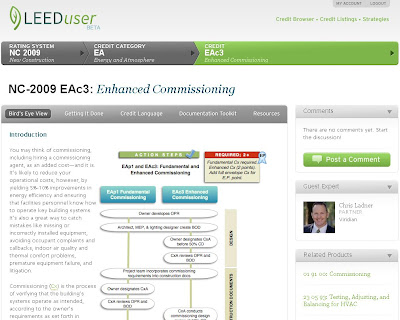
LEEDuser

LEEDuser.com

LEEDuser is currently in beta and is being developed by the fine folks over at BuildingGreen. The basic goal is to move beyond the reference guide to provide support for LEED AP's, including samples documents and templates (e.g. OPR and BOD templates for EAp1, Fundamental Commissioning). If they did nothing other than provide those templates it would be worthwhile, though the site aims to go much further by using seasoned professionals to provide practical explanations of how to actual go about finishing the credits.

Though they plan on charging a membership fee in the future, for a limited time the site is open to all. Right now only selected credits are released, though ultimately the site is designed to support all major systems, integrate with their GreenSpec product directory, and provide a "strategies" section featuring topics such as green roofs and porous paving.

First Take

If you've been a long time reader of this site you might remember that I think these guys are top-notch, and what I've seen on the site so far gives me no reason to expect anything less from LEEDuser. It's certainly not perfect (the "Getting It Done" section in each credit could be better organized), but the fact that there even is a "Getting it Done" section lends support to the fact that they're on the track.

GreenSource

GreenSource Green Building Project Database

The profiles on the Green Building Project Database from GreenSource are similar to sister publication ArchRecord's Building Types Study database, but for LEED projects. Each project features photos, total costs, climate data, product info, a magazine-style narrative (go figure), and frequently a bunch of snarky, whiny comments from perfectionist architects and designers near the bottom.

First Take

Honestly there's not a whole lot that's new here (see similar EERE database), but it's always nice to have more projects to choose from. My favorite aspect of the site is are the multitude of browsing bars along the left side of the screen that are organized through conventional topics such as project size and building type and more interesting categories like annual purchased energy, carbon footprint, and climate zones. Maybe not worth checking out right away, but definitely a good place to visit when looking for ideas.

HPB

High Performing Buildings

This last site is better as a magazine than an interesting website. High Performing Buildings is an official ASHRAE publication and the website version is pretty much what you'd expect from a bunch of engineers: clunky, with a confusing interface, but featuring rock solid content. One of these issues landed on my desk a few months ago, and I've since subscribed (free to the trade). Most of the articles are in-depth profiles of a high-efficiency system installation or building component. There's nothing really specific about LEED here, but as someone trained as an architect I appreciate the easy to understand descriptions of complex mechanical and electrical systems.

First Take

I've been impressed with the features and writing here and look forward to more in the future. The website is kind of pathetic, but that's not really the point. Since this quarterly publication was first released last year, it's not like to it's too difficult to find an older article anyway. The magazine is well put together, and even though it's probably not the most eco-friendly thing to recommend I would suggest sticking with the hard copy.

Aware of a good resource I missed? Share with your friends by leaving a comment.