Determining Occupancy: Hotel Edition

I was recently asked how to determine occupancy for hotel rooms, found a credit interpretation ruling that included an acceptable formula, and decided to share it with you here! A CIR dated 5/13/2007 for a LEED-NCv2.1 project essentially stated that you would count all of the employees as full-time equivalent (FTE) occupants, and that you could use a multiplier for the persons/hotel room to determine a transient occupancy for the building.

The design team proposed that you would take the number of hotel rooms and multiply that by an average number of guests per occupied room of 2 people/room. Then multiply that number by the average room occupancy per night, which according to the American Hotel & Lodging Association is 63.1% for 2007. That leaves us with the following:

Hotel Rooms * 2 Guests/Room * .631 Occupancy Average = Transient Occupants

So for a hotel with 100 rooms you would get a result of 126.2, which after rounding leaves us with a transient occupancy of 127 for the hotel. Add to that the number of employees provided by the owner and you have your peak loading. Determining the number of FTEs is unfortunately up to you, as I would suspect this number varies greatly depending on whether the property is full or limited service, budget or luxury, etc. If anyone has any advice for FTE rules of thumb for hotels please share!

BONUS! Another CIR dated 9.14.2006 discussed the fact that hotel guests could reasonably be excluded from the bicycle rack requirements due to the serious doubt that anyone will be traveling from city to city overnight via bike.

Prove them wrong, naked hippie cyclist!

Hippie Cyclist

Determining Occupancy - The Original
Determining Occupancy - Residential Edition

Job o' the Vague Time Period: USGBC Central Texas-Balcones Excutive Director

U.S. Green Building Council Central Texas-Balcones Chapter is hiring its first Executive Director.

USGBC CT-B is a nonprofit organization that focuses on the transformation toward sustainable building and land development practices in Central Texas through innovation, advocacy and partnerships. The Chapter seeks a strong communicator and relationship builder to serve as our first Executive Director and take our organization to new levels of sustainability and excellence. Proven fundraising skills, systems focus, and collaborative leadership approach a must.

Send letter of interest describing relevant experiences, resume, three references, and three-year salary history to apply@usgbc-centraltexas.org by December 17, 2008. Interviews begin the week of January 4, 2009. We reserve the right to accept applications until the position is filled. Visit www.usgbc-centraltexas.org/Docs/apply/EDjob.pdf for a detailed job description and additional information.

Major Changes to LEED AP Accreditation - A One Page Primer

Immediately following the "LEED 2009: Lift Off" presentation was one from the Green Buildings Certification Institute (GBCI) titled: "GBCI: Accreditation, Certification, and More." If the previous presentation was big on fluff and light on details, this one had me scrambling to keep up at my keyboard!  Luckily, they posted a page that is uncommonly clear in listing dates for changes to occur!

Beth Holst, the Vice President Credentialing at GBCI, succinctly laid out the broad strokes of a completely revised, three-tiered accreditation system that I think is an enormously good idea! Before she started she did mention that 'legacy' LEED APs don't need to worry... "nothing is going to change for you." This is sort of a lie, but we'll get back to that later.

Tiered Credentialing

Instead of a one size fits all approach for each exam track, there is now going to be a flexible hierarchy of LEED accreditation that makes a whole lot of sense. A frequent complaint of the AP system is that it requires people to learn a lot of details that don't necessarily apply to they're everyday job. While it may be important for an architect to have detailed knowledge of every credit in the system, a contractor shouldn't be forced to memorize information about referenced standards for energy modeling or calculations for water efficiency. As a result, there is now a three tiered system:

Tier One - Green Associate

Many CEOs, marketing representatives, students, and other non-technical professionals are going to love this. The "LEED Green Associate" credential will test you only on the broad strokes of LEED... How does the LEED process work? Who needs to be involved at each stage? How do I know which rating system to use? Etc... This credential applies to all LEED systems. Once you earn this level of accreditation you can move on to the next stage:

Tier Two - LEED Accredited Professional

What was previously the only LEED AP designation is now the second tier. The basic idea is that this is where you would earn a specialized accreditation for each system. As Holst put it, "Homes are different... Neighborhood Development is really, really different", and there will be different tests for each rating system:

  • Buildings Design and Construction (LEED-NC)
  • Commercial Interiors Design and Construction (LEED-CI)
  • Operations and Maintenance (LEED-EB)
  • Homes (a new LEED-Homes track)
  • Neighborhood Design (a new LEED-ND track)

Omitted in the presentation but listed on the website is a requirement that to become a LEED AP you must now also have some form of "professional experience on at least one LEED project." This will frustrate some people for sure, but I feel it's a good step forward.

Tier Three - LEED-AP Fellow

"We're going to take our time with this through the year." This was about the only information provided about the highest credential of Fellow. Holst was very clear that they want to take their time to develop an appropriately rigorous standard for fellowship, and that was about all we heard about this.

Code of Ethics

From a brief description, there is going to be a LEED AP Code of Ethics that all current AND future LEED APs will have to abide by. Most interesting about this announcement was that Holst hinted at some sort of peer enforcement system. Apparently there will be some avenue for people to tattle on their peers who aren't promoting sustainable design as they should. In the past the USGBC has essentially steered clear of policing its ranks, so it will be interesting to see how this develops in practice.

What You Really Want to Know - Timing of Exam Updates

Aside from the times listed below, I have it on good (but not rock solid) authority that the last day to register for the current LEED-NCv2.2 and LEED-CIv2.0 exams is going to be March 31st, with GBCI to cutoff administering exams sometime around June. This should give you plenty of time to study, take, and pass the current exams should you so choose, but you don't have much time to wait!
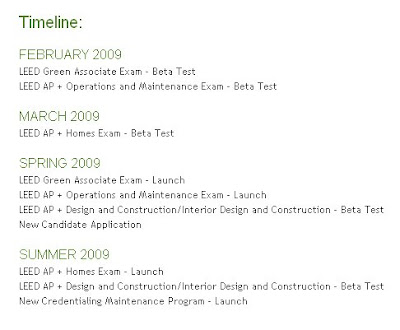
LEED 2009 AP Exams Replacement Schedule

Straight from the GBCI Website

Credentialing Maintenance

"What do legacy LEED APs have to do? Nothing..." was what Holst said, but this ain't exactly true. With the new exams will come a new credentialing maintenance program. That's right, it's just another word for continuing education requirements... BLEH! Details are a little fuzzy, but the program works in two year blocks that will be consistent with the two year LEED revision cycle.

What you'll need to do every two years:

  • Tier 1 Green Associate - 15 hours/two years - 3 LEED specific hours required
  • Tier 2 LEED AP - 30 hours - 6 LEED specific

In addition to the fact that you have to do the continuing ed, you must also now pay a bi-annual maintenance fee of $50. Current LEED AP's will get the first FREE for first 2 years but will have to pay thereafter.

There's more to this than listed here, but I just wanted to hit on the high notes. Visit the GBCI page about the new system for more details. What do you think about the changes? Please let us know by leaving a comment.

Dates for LEED 2009 Releases Announced at Greenbuild

Full disclosure - I'm not at Greenbuild right now, but I am taking advantage of the live streaming seminars on greenbuild365.org.  While 95% of the presentation was rehasing info that's been available for months, there was about a minute near the end that provided some extremely useful info!  Full disclosure number 2, I report the following as someone who watched a presentation that was frequently losing audio with no view of slides... as a result, I may have missed some info, and you should consider the following unconfirmed reports when it comes to dates.  I will be editing this post as I confirm the information.

Release Dates

Again... these are largely unconfirmed, but I'll change the post when I found out more certain information.

  • The LEED 2009 reference guides will be available in February
  • Registrations for LEED 2009 projects go live in May as well.  There is no word yet that I've seen as to when the last day for registrations will occur.

LEED-Online Improvements

On the LEED-Online front, he metioned that the 2009 rollout is built to handle a MILLION users! Hopefully the result is that staggering delays and slowness will soon be a thing of the past.

Favorite Quote

While discussing the future 2 year revision cycle for new LEED systems, Brandon mentioned that people are going to be relieved that the "USGBC has stopped acting like an organization that is so easily distracted by shiny objects." This was a perfect image of how the USGBC has acted in the past, adding rating systems in an inconsistent fashion and failing to really tackle the mundane but important logistical issues once a system is released.  I hope this marks the beginning of a new focus towards usability that will benefit everyone working on these projects.

Surprise (to me anyway) Announcement

There was mention that there is going to be a requirement to submit building performance data to the USGBC for all LEED certified buildings. Looks like I need to read through the final rating system draft to see how this is worked out. Expect an update soon.

FREE Online LEED Water Use Calculator

If you haven't found it already, Zurn has an online water use calculator that features a LEED option for comparisons. It allows you to quickly check the difference between various efficient fixtures for Water Efficiency Credit 3, Water Use Reduction. It isn't perfect (doesn't show total use reduction percentage), but it's extremely quick. It allows you to pick your scope (ie... if showers aren't in the project you simply don't include them), and the baseline fixtures are already loaded for you!

Zurn Water Use Calculator

Zurn Water Calculator

I could explain further, but just check it out yourself! Know of a better resource available for checking water use please share by leaving a comment.

Job o' the Vague Time Period: LEED Specialist, Saudi Arabia

LEED Specialist – Riyadh, Saudi Arabia

We are seeking a degreed Architect to lead our sustainability initiatives. The candidate should have a minimum Accredited Bachelor of Architecture degree with 7+ years of experience in architectural projects of varying scale, including professional experience and a familiarity with the LEED certification process. The position requires work with the development team, architects, and contractors to establish procedures and practices that will position our client as the leader of green and sustainable housing initiatives and product. The candidate should have experience sourcing and specifying green building products, analyzing green building features, and documenting green building performance. Additionally, our ideal candidate will have a conviction and passion for green initiatives and practices to provide a solid corporate foundation and focus towards this end.

Qualifications:

  • Accredited Bachelor of Architecture degree with 7+ years of experience
  • Outstanding communication skills required
  • In depth knowledge of residential building construction
  • Knowledge of green technologies and LEED rating systems
  • Experience in leading LEED design Charrettes a plus
  • AIA accreditation a plus
  • HVAC knowledge a plus
  • Willingness to relocate to Riyadh, Saudi Arabia 

If you have an interest in exploring this international opportunity, please forward your updated resume to Lori Miller and we will contact you to discuss the specifics of the opportunity. Alternatively, please forward this notice to anyone you know who may benefit from knowledge of the opportunity.